I Came for the Guitar, Not the Drama: “The Early Spring”
This blog is in progress.
I’ve been having some fun mixing hobbies recently:
- Learning Mandarin Chinese and culture
- Transcribing and arranging/covering soundtracks with unavailable or inaccurate transcriptions
Recently, I’ve been semi-watching a very popular Chinese drama on Netflix called The Early Spring.
Despite not being enthralled with the plot and characters so far, what does captivate me is the intro song, with a beautiful guitar intro featuring a gorgeous tone to die for.
As for the drama itself, it’s filled with familiar tropes of Asian dramas: the romantic male lead is a young, cold, and shrewd boss who gets into a relationship with a meek and sweet female lead who warms his cold heart (and slowly uncovers that deep down he’s actually a nice guy). At least he isn’t another CEO!
I’m curious why this seems to be such a popular romantic fantasy in East Asia. Maybe if I improve my Chinese and pay more attention, I’ll grow to like this show more.
The Song: “Her” (她) by Liu Yuning
The song is titled 她 (Her), performed by Liu Yuning (刘宇宁) for The Early Spring soundtrack.
Links:
Here’s a guitar intro performance I found. I’m not sure if this is the original musician, but he nails the guitar intro.
My Guitar Transcription
I’ve made a preliminary guitar tab in MuseScore with mostly accurate notes, but the timing is off (I can’t be bothered with transcribing the timing perfectly for now). As I improve it, I’ll add updated versions.
Guitar transcription:
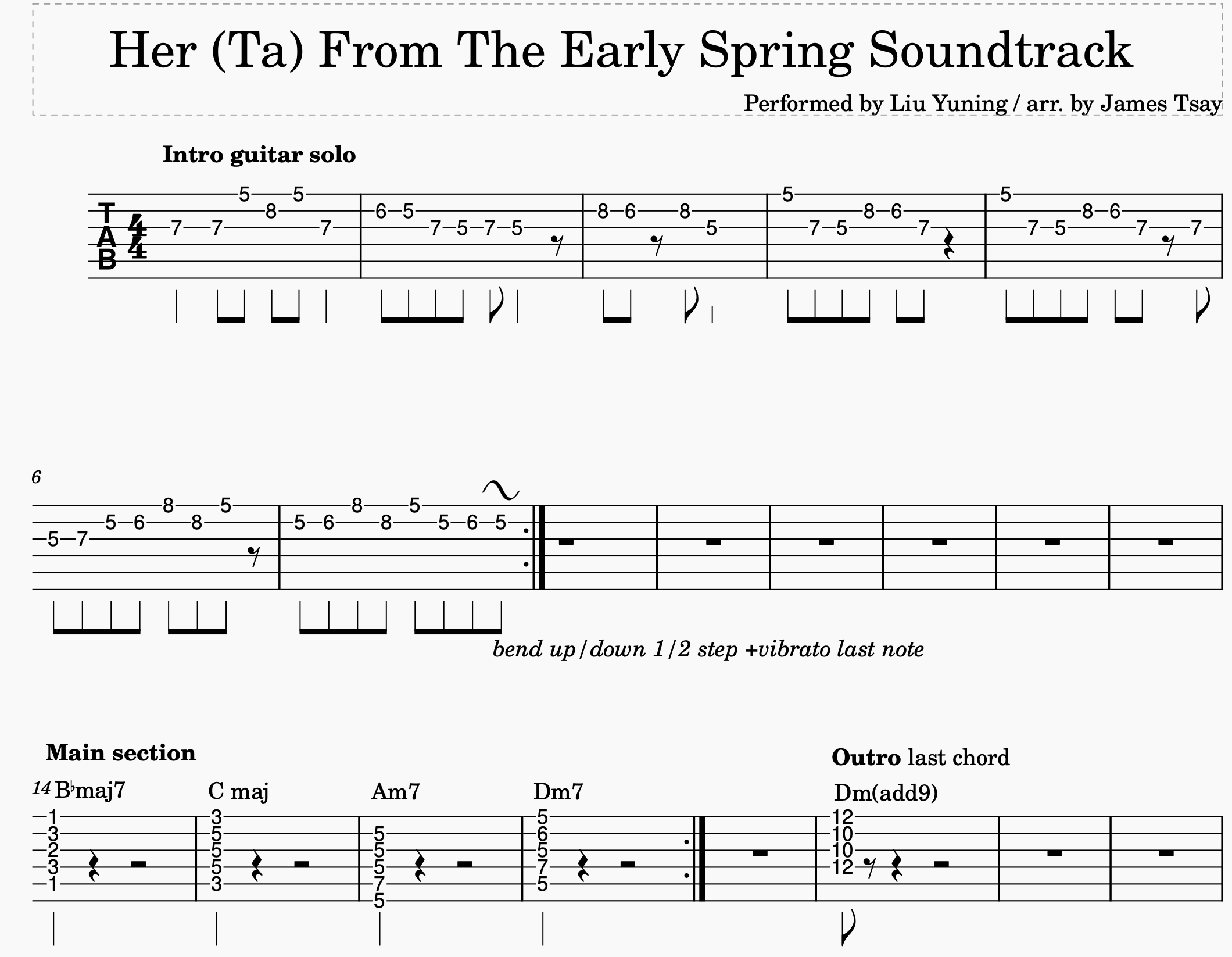
Guitar tone notes:
The tone sounds like a Stratocaster-type guitar with single-coil pickups in the 4th position (neck and middle pickups), played clean with heavy reverb.
The last E note of the solo intro is bent up and released for resolution.
I’ll see if I can post a recording of the guitar part at least later (to be updated).
A Little Music Theory
I was having some difficulty transcribing the piece by ear and looked at some websites that had major inaccuracies. They didn’t seem correct to my ears or from a music theory standpoint.
For example, the existing transcriptions I found list the first chord as A# major. B♭ is the more conventional notation in this progression, and I think adding a major 7th sounds better and gives more tension. The minor chords also sound better to my ears as 7ths.
Also, the guitar is more complementary and in the background for the rest of the song, so I wanted to put some more meaty guitar chords into the progression in case people want to cover the song fully on guitar.
After my own analysis, fiddling with chords on my guitar, and feeding questions to ChatGPT, I settled on the following progression:
B♭maj7 – C – Am7 – Dm7
The very last (ending) chord played on piano can be played on guitar as Dm(add9), which I note in the transcription.
The opening B♭maj7 adds some warmth/atmosphere progressing to C, and the downward direction to Am7 and then back up to Dm7 sounds like another deeper thought after introspection (from my emotional interpretation). The progression can be interpreted in F major or its relative minor, D minor, contributing to the song’s melancholic character.
Timing: 4/4 time, approximately 74 BPM.
Unfortunately, I don’t have the vocal range of Liu Yuning, so I’ll spare you from listening to an out-of-tune full cover for now.
Some Thoughts on East Asian Pop Music
Philosophically and culturally, I’m interested in why these kinds of songs and chord progressions seem so popular in East Asian pop music, and perhaps less prevalent in contemporary Western pop.
Interestingly, ChatGPT also pointed out that this song uses a variation of the widely used IV–V–iii–vi progression, particularly associated with East Asian pop ballads and Japanese pop music. Claude told me it is also known as the Royal Road progression (王道進行, ōdō shinkō) in Japanese pop.
If you want to get academic, this is a paper analyzing its prevalence in J-pop! Maxwell Ramage, “The Royal Road Progression in Japanese Popular Music,” Music Theory Spectrum 45(2): 238–256 (2023).
I can’t open the full paper (only the abstract). However, Wikipedia, citing the paper, says 40% of Japan’s top twenty best-selling singles of all time contain it, and that the year’s top-selling song had it 23% of the time between 1989 and 2019.
Why is this particular kind of atmospheric, moody, and melancholic music so appealing? Western music certainly has plenty of melancholy too in romantic material, but maybe there are differences in how different cultures express and feel these emotions through music.
It’s something I’d like to explore further, perhaps by comparing musical and cultural tastes across Chinese, Japanese, Korean, and Western pop music, dramas, and other art forms.
For now, this song is definitely ear candy, and I give respect to the composer and musicians.